
- Posts: 31
- Thank you received: 7
 verkünder
- verkünder
-
 Topic Author
- Offline
- Junior Member
-

Less
More
12 Jul 2013 10:53 #34534
by verkünder
 20 ml kaltes Wasser mit Hilfe einer Einmalspritze (Größe:10 ml)und einer dicken Spritzennadel (genannt Spritzenkanüle) aus einem sauberen Glas Wasser abmessen und in das Glasfläschchen spritzen, und dann ab damit in den Kühlschrank!
(Der Tropfaufsatz des Fläschchen wurde bereits für die anschließende Prozedur entfernt und wird erst nach der Aktivierung wieder aufgesetzt.)
Dann mit der gleichen Einmalspritze (Größe:10 ml) mit einer dicken Spritzennadel (genannt Spritzenkanüle) aus dem gut gekühlten MMS-Fläschchen genau
1 ml MMS (Natriumchloritlösung 28%) aufziehen, Nadel anschließend vorsichtig mit einem Papiertuch kurz abputzen.
Sofort danach die Nadel (der selben Spritze) in die auch gut gekühlte Zitronensäure-Flaschestecken und von der 50 %ige Zitronensäure genau 0,3 ml aufziehen. Man zieht noch etwa 0,5 ml Luft in die Einmalspritze, damit die anschließende Aktivierung nicht zu stürmisch verläuft und durch eine Art Luftpolster geschützt wird.
Jetzt wird MMS direkt in der Spritze zusammen mit der Zitronensäure (50%)
30 Sekunden aktiviert.
Wir können dabei beobachten, wie sich die Mixtur im Spritzeninneren gelblich-rötlich-bräunlich verfärbt. Das geht sehr schnell!
Beim Aktivieren wird das dabei entstehende Chlordioxid tropfenweise versuchen, durch die Nadel aus der Spritze zu entweichen, weil es gasförmig ist.
Wir beugen dem vor, indem wir die Nadel schon beim Aktivieren in das fast flach liegende Wasserfläschchen einführen, sodaß das frei werdende Chlordioxid nicht in die Luft entweichen kann, sondern sofort durch die Nadel ins Wasser geleitet und dort gebunden werden kann.
(Aufpassen, daß kein Wasser dabei aus dem Fläschchen auslaufen kann! Kreativität ist hier gefragt!
Wir gewinnen auf diese Weise die größtmögliche Ausbeute vom wertvollen Chlordioxid.
Nach der Aktivierungszeit von 30 Sekunden (50%) spritzen wir den gesamten Spritzeninhalt in das Fläschchen mit dem vorbereiteten abgekühlten Wasser, befestigen den Tropfer wieder auf der Flaschenöffnung, verschließen das Fläschchen gut mit seinem Verschluß (Deckel), schütteln es kurz.... und dann sofort ab damit in den Kühlschrank!
Bitte das Fläschchen mit einem Aufkleber o.ä. gut kennzeichnen, z.B. "Gefeu-Lösung", damit wir es nicht mit unserem MMS- Fläschchen im Kühlschrank verwechseln!!!
Ganz wichtig!!!!
Ab sofort ist diese Lösung einsetzbar. Ich selbst warte aber meistens noch
ca. 1 Stunde, bevor ich meine erste Dosis davon entnehme.
Es empfiehlt sich, dieses Rezept gleich doppelt anzusetzen, weil sich auf diese Weise mehr Volumen im Fläschchen befindet und das Chlordioxid sicherer gebunden bleibt:
Also mit 50%iger Zitronensäure:
40 ml Wasser + 2 ml MMS + 0,6 ml Zitronensäure (50%) + 0,5 ml Luft
Meine frage ist das eine gute Rezeptur sie ist nicht von mir.
Gott schütze euch und unsere bischhöfe Verkünder
verkünder was created by verkünder
20 ml kaltes Wasser mit Hilfe einer Einmalspritze (Größe:10 ml)und einer dicken Spritzennadel (genannt Spritzenkanüle) aus einem sauberen Glas Wasser abmessen und in das Glasfläschchen spritzen, und dann ab damit in den Kühlschrank!(Der Tropfaufsatz des Fläschchen wurde bereits für die anschließende Prozedur entfernt und wird erst nach der Aktivierung wieder aufgesetzt.)
Dann mit der gleichen Einmalspritze (Größe:10 ml) mit einer dicken Spritzennadel (genannt Spritzenkanüle) aus dem gut gekühlten MMS-Fläschchen genau
1 ml MMS (Natriumchloritlösung 28%) aufziehen, Nadel anschließend vorsichtig mit einem Papiertuch kurz abputzen.
Sofort danach die Nadel (der selben Spritze) in die auch gut gekühlte Zitronensäure-Flaschestecken und von der 50 %ige Zitronensäure genau 0,3 ml aufziehen. Man zieht noch etwa 0,5 ml Luft in die Einmalspritze, damit die anschließende Aktivierung nicht zu stürmisch verläuft und durch eine Art Luftpolster geschützt wird.
Jetzt wird MMS direkt in der Spritze zusammen mit der Zitronensäure (50%)
30 Sekunden aktiviert.
Wir können dabei beobachten, wie sich die Mixtur im Spritzeninneren gelblich-rötlich-bräunlich verfärbt. Das geht sehr schnell!
Beim Aktivieren wird das dabei entstehende Chlordioxid tropfenweise versuchen, durch die Nadel aus der Spritze zu entweichen, weil es gasförmig ist.
Wir beugen dem vor, indem wir die Nadel schon beim Aktivieren in das fast flach liegende Wasserfläschchen einführen, sodaß das frei werdende Chlordioxid nicht in die Luft entweichen kann, sondern sofort durch die Nadel ins Wasser geleitet und dort gebunden werden kann.
(Aufpassen, daß kein Wasser dabei aus dem Fläschchen auslaufen kann! Kreativität ist hier gefragt!
Wir gewinnen auf diese Weise die größtmögliche Ausbeute vom wertvollen Chlordioxid.
Nach der Aktivierungszeit von 30 Sekunden (50%) spritzen wir den gesamten Spritzeninhalt in das Fläschchen mit dem vorbereiteten abgekühlten Wasser, befestigen den Tropfer wieder auf der Flaschenöffnung, verschließen das Fläschchen gut mit seinem Verschluß (Deckel), schütteln es kurz.... und dann sofort ab damit in den Kühlschrank!
Bitte das Fläschchen mit einem Aufkleber o.ä. gut kennzeichnen, z.B. "Gefeu-Lösung", damit wir es nicht mit unserem MMS- Fläschchen im Kühlschrank verwechseln!!!
Ganz wichtig!!!!
Ab sofort ist diese Lösung einsetzbar. Ich selbst warte aber meistens noch
ca. 1 Stunde, bevor ich meine erste Dosis davon entnehme.
Es empfiehlt sich, dieses Rezept gleich doppelt anzusetzen, weil sich auf diese Weise mehr Volumen im Fläschchen befindet und das Chlordioxid sicherer gebunden bleibt:
Also mit 50%iger Zitronensäure:
40 ml Wasser + 2 ml MMS + 0,6 ml Zitronensäure (50%) + 0,5 ml Luft
Meine frage ist das eine gute Rezeptur sie ist nicht von mir.
Gott schütze euch und unsere bischhöfe Verkünder
The following user(s) said Thank You: JB13
Please Log in or Create an account to join the conversation.
- JB13
-
- Offline
- Platinum Member
-

12 Jul 2013 18:26 #34544
by JB13
Replied by JB13 on topic verkünder
Verkünder, habe ich machen MMSA in ähnlicher Weise so nicht ClO2 Gas zu verlieren und um eine höhere Konzentration ppm ClO2 machen. Das rechte Foto zeigt ein Glas Reaktor in einem Glas-Empfänger, wurde gekippt hat sich so den Reaktor Lösungen MMSU und 50% CA-Mix in das destillierte Wasser nach der Reaktion im Reaktor 1 Stunde. Wie machen CDS und dann verschüttet in das destillierte Wasser.
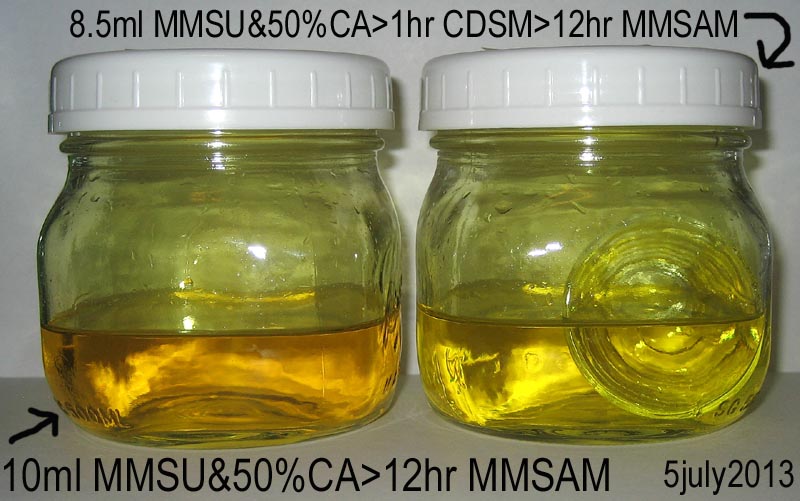
Wenn alle drei Bestandteile sind nach der 1-Stunden-Modus CDS gemischt, wird die Reaktion für weitere 12 Stunden bei Raumtemperatur, dann in den Kühlschrank.
Das macht sehr starke MMSA und die ClO2-Gas ist nicht alles verloren. Wenn Sie fertig sind Umsetzen bei Raumtemperatur für insgesamt 13 Stunden wird die Receiver + Reaktor wird im Kühlschrank abkühlen setzen. Nur, wenn die Lösung kalt ist der Empfänger immer top entfernt, nehmen Sie einige MMSA mit einer Spritze. Diese Methode scheint gut zu funktionieren als sehr potent MMSA ist.
Das Foto auf der linken Seite zeigt MMSA durch die Kombination aller drei Zutaten, MMSU, 50% CA und destilliertem Wasser alle auf einmal gemacht. Der Deckel wird dann schnell aufgesetzt und die Reaktion bei Raumtemperatur für 12 Stunden. Dann wird es in den Kühlschrank bis zum Erkalten gebracht und erst dann wird der Deckel entfernt, nehmen Sie einige MMSA.
Beide Methoden scheinen die gleiche Menge an ClO2 erzeugen. Ich weiß nicht, warum die Lösung in der linken Foto ist dunkler.
Verkünder, I have been making MMSA in a similar way so not to lose ClO2 gas and to make a higher ClO2 ppm concentration. The right photo show a glass reactor inside a glass receiver that has been tipped over so the reactor solutions of MMSU and 50% CA mix into the distilled water after reacting in the reactor for 1 hour. Like making CDS and then spilled into the distilled water.
When all three ingredients are mixed together after the 1 hour CDS mode, the reaction continues for another 12 hours at room temperature, then into the fridge.
This makes very strong MMSA and the ClO2 gas is not lost. When finished reacting at room temperature for a total of 13 hours, the receiver + reactor is put in the fridge to cool down. Only when the solution is cold is the receiver top ever removed to take out some MMSA with a syringe. This method seems to work well as very potent MMSA is made.
The photo on the left shows MMSA being made by combining all three ingredients, MMSU, 50% CA and distilled water all at one time. The lid is then quickly put on and the reaction takes place at room temperature for 12 hours. Then, it is placed in the fridge until cool and only then is the lid removed to take out some MMSA.
Both methods seem to produce the same amount of ClO2. I do not know why the solution in the left photo is darker.
Wenn alle drei Bestandteile sind nach der 1-Stunden-Modus CDS gemischt, wird die Reaktion für weitere 12 Stunden bei Raumtemperatur, dann in den Kühlschrank.
Das macht sehr starke MMSA und die ClO2-Gas ist nicht alles verloren. Wenn Sie fertig sind Umsetzen bei Raumtemperatur für insgesamt 13 Stunden wird die Receiver + Reaktor wird im Kühlschrank abkühlen setzen. Nur, wenn die Lösung kalt ist der Empfänger immer top entfernt, nehmen Sie einige MMSA mit einer Spritze. Diese Methode scheint gut zu funktionieren als sehr potent MMSA ist.
Das Foto auf der linken Seite zeigt MMSA durch die Kombination aller drei Zutaten, MMSU, 50% CA und destilliertem Wasser alle auf einmal gemacht. Der Deckel wird dann schnell aufgesetzt und die Reaktion bei Raumtemperatur für 12 Stunden. Dann wird es in den Kühlschrank bis zum Erkalten gebracht und erst dann wird der Deckel entfernt, nehmen Sie einige MMSA.
Beide Methoden scheinen die gleiche Menge an ClO2 erzeugen. Ich weiß nicht, warum die Lösung in der linken Foto ist dunkler.
Verkünder, I have been making MMSA in a similar way so not to lose ClO2 gas and to make a higher ClO2 ppm concentration. The right photo show a glass reactor inside a glass receiver that has been tipped over so the reactor solutions of MMSU and 50% CA mix into the distilled water after reacting in the reactor for 1 hour. Like making CDS and then spilled into the distilled water.
When all three ingredients are mixed together after the 1 hour CDS mode, the reaction continues for another 12 hours at room temperature, then into the fridge.
This makes very strong MMSA and the ClO2 gas is not lost. When finished reacting at room temperature for a total of 13 hours, the receiver + reactor is put in the fridge to cool down. Only when the solution is cold is the receiver top ever removed to take out some MMSA with a syringe. This method seems to work well as very potent MMSA is made.
The photo on the left shows MMSA being made by combining all three ingredients, MMSU, 50% CA and distilled water all at one time. The lid is then quickly put on and the reaction takes place at room temperature for 12 hours. Then, it is placed in the fridge until cool and only then is the lid removed to take out some MMSA.
Both methods seem to produce the same amount of ClO2. I do not know why the solution in the left photo is darker.
The following user(s) said Thank You: verkünder
Please Log in or Create an account to join the conversation.
- verkünder
-
Topic Author
- Offline
- Junior Member
-
Less
More
- Posts: 31
- Thank you received: 7
12 Jul 2013 19:46 #34550
by verkünder
Bei dieser rezeptur brauchen wir weniger Wiederholungen 3-4 mal am tag bis zu 20 tropfen,und der Geschmack,.ist fast verschwunden.
im übrigen gegen den schlechten Geschmack,versuch mal einen schuss milch mit rohrzucker
.
 verkünder
Replied by verkünder on topic verkünder
Bei dieser rezeptur brauchen wir weniger Wiederholungen 3-4 mal am tag bis zu 20 tropfen,und der Geschmack,.ist fast verschwunden.im übrigen gegen den schlechten Geschmack,versuch mal einen schuss milch mit rohrzucker
.
verkünder Please Log in or Create an account to join the conversation.
Time to create page: 0.315 seconds
The MMS HEALTH RECOVERY GUIDEBOOK is Jim’s latest book. It provides the latest information on how to safely use MMS. Click the book image to order your copy today.
Jim's Blog
-
Unpleasant Symptoms, Biofilms, Going Too Fast
Published on: October 14, 2026
Note: In a health context, a biofilm is a structured, highly organized community of microorganisms (such as bacteria or fungi) that adheres to a surface and is encased within a self-produced, sticky, gel-like matrix of proteins, DNA, and sugars. Instead of floating freely as individual cells, the microbes (bad stuff) physically cluster together to form …
-
Cravings/Weight Management/Blocked Veins
Published on: October 4, 2026
A conversation with Jim in 2010: D: Some doctors have told me that harmful pathogens have the ability to manipulate the brain chemistry to make you crave the things they want to eat. Since I have been on MMS/CD, I have lost all cravings. I have also lost 60 pounds (which I needed to lose), …
-
Flu Season
Published on: September 28, 2026
The flu is a lot more dangerous sometimes than people realize and flu can make you very, very sick. There are some flu’s today that are highly resistant to most everything. So with flu and colds that just won’t go away and with pneumonia, here is another suggested approach you can try if the standard …
-
Making Health Decisions
Published on: September 22, 2026
Following is Jim’s answer to someone who was struggling with trying to get a loved one to follow certain procedures regarding their health: Jim: It is important to understand, that what a person decides to do about their own health is a very personal matter. In addition, there are so many factors involved in making …
-
MMS/CD and Antioxidants
Published on: September 14, 2026
Some folks get confused and a bit hung up on the issue of MMS/CD and antioxidants. While it is true, we have said and many others emphasize, you cannot take MMS/CD with antioxidants. Fair enough, it stands to reason that taking antioxidants with an oxidizer is not the best thing to do. BUT, you have …
-
Why it’s Not Working
Published on: September 2, 2026
From a discussion with Jim on why MMS/CD doesn’t seem to be working: Jim: If it’s not working, do something different. But this can be tricky, you have to give each thing enough time to work, don’t be rash, but don’t stay stuck either, this is where listening to your body comes in and the …