
- Posts: 111
- Thank you received: 22
 Materials for containers
- hannelore.sander
-
 Topic Author
- Offline
- Premium Member
-

Less
More
13 Feb 2018 15:31 #57574
by hannelore.sander
Materials for containers was created by hannelore.sander
I need to buy a number of small containers (1/4 to 1 oz) for all my liquids. I travel a lot. I am confused as to what materials to get since MMS (and CDS?) corrode things. What is the difference between LDPE, HDPE, PET, PVC, Glass, etc. Which ones are not good? Right now, I have many small brown glass bottles but they have dropper tops with rubber bulbs, and I have to take those off and use caps, which then don’t have the proper dispensers. Is it ok to always use plastic? Do you know of a company that sells such containers in small companies. Thank you.
Please Log in or Create an account to join the conversation.
- CLO2
-

- Offline
- Administrator
-

14 Feb 2018 05:59 - 14 Feb 2018 06:14 #57580
by CLO2
Replied by CLO2 on topic Materials for containers
Glass should be the best. I have had HDPE bottles destroyed by MMS (22.4% sodium chlorite solution) in a few months time.
Those brown colored glass bottles should be excellent. Just find caps without droppers attached. It is safest to transport these chemicals in glass bottles with solid caps and double-bagged in case of leakage or breakage.
When you need to take out a dose, use a separate dropper cap, syringe or pipette. Make sure to label the droppers, syringes and pipettes so you don't cross contaminate any solutions.
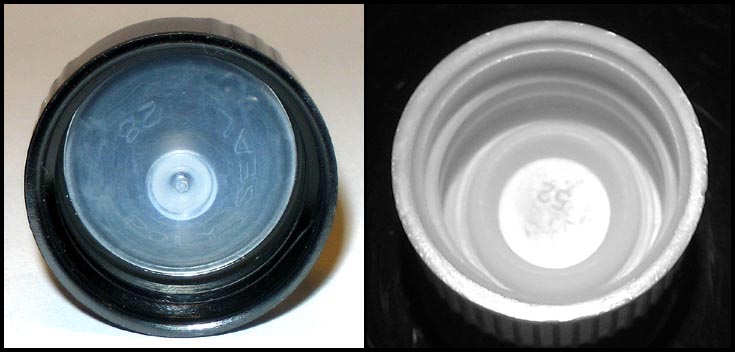
If you rinse a dispenser very well, you can use just one dropper, syringe or pipette for all the different solutions. You can find plastic bottles with dispenser caps, but they can leak. Here are two types of caps I have successfully used.
Those brown colored glass bottles should be excellent. Just find caps without droppers attached. It is safest to transport these chemicals in glass bottles with solid caps and double-bagged in case of leakage or breakage.
When you need to take out a dose, use a separate dropper cap, syringe or pipette. Make sure to label the droppers, syringes and pipettes so you don't cross contaminate any solutions.
If you rinse a dispenser very well, you can use just one dropper, syringe or pipette for all the different solutions. You can find plastic bottles with dispenser caps, but they can leak. Here are two types of caps I have successfully used.
- hannelore.sander
-
Topic Author
- Offline
- Premium Member
-
Less
More
- Posts: 111
- Thank you received: 22
14 Feb 2018 21:19 #57586
by hannelore.sander
Replied by hannelore.sander on topic Materials for containers.!
Dear CLO2, would you mind very much googling a specific glass bottle with a dropper cap to see if it would be suitable, I.e., would the plastic insert hold up against MMS. I don’t know how to attach a link to this request otherwise I would do so. It’s a 5ml glass bottle with a European dropper cap. Comes in blue, green and amber, and many companies make it. It seems ideal for traveling and I would not have to carry extra dispensers with me.
Please Log in or Create an account to join the conversation.
- CLO2
-
- Offline
- Administrator
-
14 Feb 2018 22:53 #57590
by CLO2
Replied by CLO2 on topic Materials for containers.!
Here
is one sold by Amazon. They are meant for essential oil use. I have no idea what the dropper cap and dispenser are made from and could not find that info on the Amazon web page.
I looked at my glass essential oil bottles & caps and one cap looks like bakelite (black) which I know would not stand up to MMS. Another cap was also bakelite but had a white plastic insert that may resist MMS and CLO2.
You could try using them and see what happens to the plastic caps/dispensers.
Personally I would not use those, but instead find caps for glass bottles that will resist MMS and CLO2 and carry one small pipette.
I looked at my glass essential oil bottles & caps and one cap looks like bakelite (black) which I know would not stand up to MMS. Another cap was also bakelite but had a white plastic insert that may resist MMS and CLO2.
You could try using them and see what happens to the plastic caps/dispensers.
Personally I would not use those, but instead find caps for glass bottles that will resist MMS and CLO2 and carry one small pipette.
Please Log in or Create an account to join the conversation.
Time to create page: 0.278 seconds
The MMS HEALTH RECOVERY GUIDEBOOK is Jim’s latest book. It provides the latest information on how to safely use MMS. Click the book image to order your copy today.
Jim's Blog
-
Unpleasant Symptoms, Biofilms, Going Too Fast
Published on: October 14, 2026
Note: In a health context, a biofilm is a structured, highly organized community of microorganisms (such as bacteria or fungi) that adheres to a surface and is encased within a self-produced, sticky, gel-like matrix of proteins, DNA, and sugars. Instead of floating freely as individual cells, the microbes (bad stuff) physically cluster together to form …
-
Cravings/Weight Management/Blocked Veins
Published on: October 4, 2026
A conversation with Jim in 2010: D: Some doctors have told me that harmful pathogens have the ability to manipulate the brain chemistry to make you crave the things they want to eat. Since I have been on MMS/CD, I have lost all cravings. I have also lost 60 pounds (which I needed to lose), …
-
Flu Season
Published on: September 28, 2026
The flu is a lot more dangerous sometimes than people realize and flu can make you very, very sick. There are some flu’s today that are highly resistant to most everything. So with flu and colds that just won’t go away and with pneumonia, here is another suggested approach you can try if the standard …
-
Making Health Decisions
Published on: September 22, 2026
Following is Jim’s answer to someone who was struggling with trying to get a loved one to follow certain procedures regarding their health: Jim: It is important to understand, that what a person decides to do about their own health is a very personal matter. In addition, there are so many factors involved in making …
-
MMS/CD and Antioxidants
Published on: September 14, 2026
Some folks get confused and a bit hung up on the issue of MMS/CD and antioxidants. While it is true, we have said and many others emphasize, you cannot take MMS/CD with antioxidants. Fair enough, it stands to reason that taking antioxidants with an oxidizer is not the best thing to do. BUT, you have …
-
Why it’s Not Working
Published on: September 2, 2026
From a discussion with Jim on why MMS/CD doesn’t seem to be working: Jim: If it’s not working, do something different. But this can be tricky, you have to give each thing enough time to work, don’t be rash, but don’t stay stuck either, this is where listening to your body comes in and the …