
- Posts: 21
- Thank you received: 7
 Questions about oxidation potential in Volts
- Infinitely Curious
-
 Topic Author
- Offline
- Junior Member
-

Less
More
20 Dec 2019 03:46 #61939
by Infinitely Curious
Questions about oxidation potential in Volts was created by Infinitely Curious
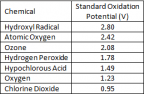
Andreas Kalcker explains that our cells support about 1.3 V, the oxygen voltage. Jim Humble mentioned 1.1 to 1.5 V in some videos. But Ozone has 2.04 V. So why do we support intravenous Ozone ? Shouldn't it destroy all of our cells ? Or does it just cause a tolerable level of damage ?
In regards to Chlorine Dioxide, the first oxidation reaction that will occur is:
Reaction 1) CLO2 + e¯ => CLO2¯ ( E ~0.95 V )
Moreover, the resulting chlorite molecule CLO2¯ may eventually release both of it's oxygen atoms and get reduced to the chloride molecule CL¯. The following reactions are simplified:
Reaction 2) CLO2¯ + 2e¯ => CLO¯ + O... ( E ~0.76 V )
Reaction 3) CLO¯ + 2e¯ => CL¯ + O... ( E ~0.90 V )
So the liquid form of CD has an maximum oxidation potential of 0.95 V, under normal conditions. However, in very acidic environment it rises up to 1.5 V, which is the same oxidation potential of CD in gas form. Right? Now, we have a very acid stomach and some small amount of CD will likely evaporate in our intestines. And we seem to handle that pretty well, so does that mean that our digestive tract supports 1.5 V ?
Going further, all above is about CD outside our cells. But it can penetrate cell walls too, right ? Especially when DMSO is added. That's when it works at mitochondrial level, right?
When it enters our cells, are our cell inner parts still having a 1.1 to 1.5 V resistance ? What about our cell nucleous, is it surviving to CD because our DNA is kept in a very compact form ?
In regards to Chlorine Dioxide, the first oxidation reaction that will occur is:
Reaction 1) CLO2 + e¯ => CLO2¯ ( E ~0.95 V )
Moreover, the resulting chlorite molecule CLO2¯ may eventually release both of it's oxygen atoms and get reduced to the chloride molecule CL¯. The following reactions are simplified:
Reaction 2) CLO2¯ + 2e¯ => CLO¯ + O... ( E ~0.76 V )
Reaction 3) CLO¯ + 2e¯ => CL¯ + O... ( E ~0.90 V )
So the liquid form of CD has an maximum oxidation potential of 0.95 V, under normal conditions. However, in very acidic environment it rises up to 1.5 V, which is the same oxidation potential of CD in gas form. Right? Now, we have a very acid stomach and some small amount of CD will likely evaporate in our intestines. And we seem to handle that pretty well, so does that mean that our digestive tract supports 1.5 V ?
Going further, all above is about CD outside our cells. But it can penetrate cell walls too, right ? Especially when DMSO is added. That's when it works at mitochondrial level, right?
When it enters our cells, are our cell inner parts still having a 1.1 to 1.5 V resistance ? What about our cell nucleous, is it surviving to CD because our DNA is kept in a very compact form ?
Please Log in or Create an account to join the conversation.
- CLO2
-

- Offline
- Administrator
-

20 Dec 2019 06:32 #61941
by CLO2
Replied by CLO2 on topic Questions about oxidation potential in Volts
"Andreas Kalcker explains that our cells support about 1.3 V, the oxygen voltage. Jim Humble mentioned 1.1 to 1.5 V in some videos."
The attached PDF file may be of interest to you. The PDF is at the very bottom of this post.
The attached PDF file may be of interest to you. The PDF is at the very bottom of this post.
The following user(s) said Thank You: Infinitely Curious
Please Log in or Create an account to join the conversation.
- Infinitely Curious
-
Topic Author
- Offline
- Junior Member
-
Less
More
- Posts: 21
- Thank you received: 7
20 Dec 2019 15:55 #61942
by Infinitely Curious
Replied by Infinitely Curious on topic Questions about oxidation potential in Volts
CLO2,
Thanks for the paper, which I also saw in other post too. It adds a important statement :
"In contrast to oxygen, therefore, chlorine dioxide can readily react with certain amino acids (e.g. cysteine, tryptophan and tyrosine), lipids, and other biological materials."
However, I can't find much information about the amount of volts a human cell can resist. The only text found about this subject is from a book, which only describes much lower standard reduction potentials for various biological components. For instance:
-0.5 V to -0.72 V for glucose.
-0.32 V for NADH <=> NAD+
+0.76 V for Iron oxidation Fe+2 <=> Fe+3
+0.82 V for oxygen/water electron exchanging pair
source: book.bionumbers.org/what-is-the-redox-potential-of-a-cell/
So, I guess that the specifying that human cells can support a given amount of voltage is an oversimplified statement... ?
Thanks for the paper, which I also saw in other post too. It adds a important statement :
"In contrast to oxygen, therefore, chlorine dioxide can readily react with certain amino acids (e.g. cysteine, tryptophan and tyrosine), lipids, and other biological materials."
However, I can't find much information about the amount of volts a human cell can resist. The only text found about this subject is from a book, which only describes much lower standard reduction potentials for various biological components. For instance:
-0.5 V to -0.72 V for glucose.
-0.32 V for NADH <=> NAD+
+0.76 V for Iron oxidation Fe+2 <=> Fe+3
+0.82 V for oxygen/water electron exchanging pair
source: book.bionumbers.org/what-is-the-redox-potential-of-a-cell/
So, I guess that the specifying that human cells can support a given amount of voltage is an oversimplified statement... ?
Please Log in or Create an account to join the conversation.
- Lauge
-

- Offline
- Junior Member
-
Less
More
- Posts: 22
- Thank you received: 8
24 Feb 2020 16:11 #62570
by Lauge
Replied by Lauge on topic Questions about oxidation potential in Volts
I'm curious to know if there has been any testing done of the claim stated in this document you link to CLO2?
"In contrast to oxygen, therefore, chlorine dioxide can readily react with certain amino acids (e.g. cysteine, tryptophan and tyrosine), lipids, and other biological materials."
This statement seems to suggest, that the oxidation potential that we should compare with, when comparing to oxygen, is not the 0.95v. which is always showed when comparing Chlorine Dioxide and Oxygen.
Also the brought statement that Chlorine Dioxide can readily react with lipids and other biological materials seems a lot more unspecific and untested than the statement that it can react with CERTAIN amino acids (which is also stated on various sites where they also say it does not react with RNA.)
Does this mean that Chlorine Dioxide will react with lipids (healthy fat tissue) and unspecified biological material?
Im guessing, since Jim Humble writes that Chlorine Dioxide does not react with healthy body tissue, he must have knowledge on this and done some testing on it?
Thank you for any knowledge you are able to share on this matter.
"In contrast to oxygen, therefore, chlorine dioxide can readily react with certain amino acids (e.g. cysteine, tryptophan and tyrosine), lipids, and other biological materials."
This statement seems to suggest, that the oxidation potential that we should compare with, when comparing to oxygen, is not the 0.95v. which is always showed when comparing Chlorine Dioxide and Oxygen.
Also the brought statement that Chlorine Dioxide can readily react with lipids and other biological materials seems a lot more unspecific and untested than the statement that it can react with CERTAIN amino acids (which is also stated on various sites where they also say it does not react with RNA.)
Does this mean that Chlorine Dioxide will react with lipids (healthy fat tissue) and unspecified biological material?
Im guessing, since Jim Humble writes that Chlorine Dioxide does not react with healthy body tissue, he must have knowledge on this and done some testing on it?
Thank you for any knowledge you are able to share on this matter.
Please Log in or Create an account to join the conversation.
- Lauge
-
- Offline
- Junior Member
-
Less
More
- Posts: 22
- Thank you received: 8
01 Sep 2020 17:56 #65769
by Lauge
Replied by Lauge on topic Questions about oxidation potential in Volts
I found the following explanation in Andreas Kalcker’s book “Forbidden Health" on page 384.
“Chlorine dioxide is a selective oxidant, and unlike other substances, it doesn’t react to most living tissue components.
Chlorine dioxide does react quickly to the phenols and thiols, which are essential to bacterial life. With the phenols, the mechanism consists in attacking the ring of benzene, removing smell, taste and other intermediate compounds.[71]
Chlorine dioxide efficiently eliminates viruses and is ten times more efficient than sodium hypochlorite (bleach)[72], something proved in a comparative study.[73] It also proved high efficiency against small parasites like protozoa.[74]
Something of concern to medical professionals is how chlorine dioxide reacts with essential amino acids. In trials on chlorine dioxide’s reactivity to 21 essential amino acids, only cysteine[75], tryptophan[76], tyrosine[77], proline, and hydroxyproline[78] were reactive in a pH of around 6. These amino acids are relatively easy to replace.
Cysteine and methionine[79] are two aromatic amino acids that contain sulfur, tryptophan, and tyrosine and the two inorganic ions Fe2+ and Mn2+. Cysteine, as it belongs to the thiols groups, is an amino acid up to 50 times more reactive to all microbial systems that the other four essential amino acids, and therefore it is impossible for it to create resistance to chlorine dioxide.
Although it hasn’t been proved to date, pharmacodynamics usually presume that the cause of its antimicrobial effect is based on its reaction to the four amino acids mentioned earlier, or to the residues of proteins and peptides."
The references are linked here:
[71] Stevens, A.; Seeger, D.; Slocum, C., Products of Chlorine Dioxide Treatment
of Organic Materials in Water, Water Supply Research Div., U. S.
Environmental Protection Agency,Cincinnati, Ohio, 1977, 9
[72] Sanekata T, Fukuda T, Miura T, Morino H, Lee C et al. (2010) Evaluation
of the antiviral activity of chlorine dioxide and sodium hypochlorite against feline calicivirus, human influenza virus, measlesvirus, canine distemper virus, human herpesvirus, human adenovirus,canine adenovirus and canine 389 parvovirus. Biocontrol Sci 15/2: 45-49.doi:10.4265/bio.15.45. PubMed:
20616431.
[73] Tanner R (1989) Comparative testing and evaluation of hard-surface disin- fectants. J Ind Microbiol 4: 145-154. doi:10.1007/BF01569799
[74] EPA Guidance Manual, Alternative Disinfectants and Oxidants, 4.4.3.2 Protozoa Inactivation. Available: www.epa.gov/ogwdw/mdbp/pdf/ alter/chapt_4.pdf
[75] Ison A, Odeh IN, Margerum DW (2006) Kinetics and mechanisms of chlorine dioxide and chlorite oxidations of cysteine and glutathione.Inorg Chem 45: 8768-8775. doi:10.1021/ic0609554. PubMed:17029389
[76] Stewart DJ, Napolitano MJ, Bakhmutova-Albert EV, Margerum DW (2008) Kinetics and mechanisms of chlorine dioxide oxidation of tryptophan. Inorg Chem 47: 1639-1647. doi:10.1021/ic701761p. PubMed: 18254588
[77] Napolitano MJ, Green BJ, Nicoson JS, Margerum DW (2005) Chlorine dioxide oxidations of tyrosine, N-acetyltyrosine, and Dopa. Chem Res Toxicol 18: 501-508. doi:10.1021/tx049697i. PubMed: 15777090
[78] Tan, H.K., Wheeler, W.B., Wei, C.I., Reaction of chlorine dioxide with amino acids and peptides, Mutation Research, 188: 259-266, 1987
[79] Loginova IV, Rubtsova SA, Kuchin AV (2008) Oxidation by chlorine dioxide of methionine and cysteine derivatives to sulfoxide. Chem Nat Compd 44: 752-754. doi:10.1007/s10600-009-9182-8
“Chlorine dioxide is a selective oxidant, and unlike other substances, it doesn’t react to most living tissue components.
Chlorine dioxide does react quickly to the phenols and thiols, which are essential to bacterial life. With the phenols, the mechanism consists in attacking the ring of benzene, removing smell, taste and other intermediate compounds.[71]
Chlorine dioxide efficiently eliminates viruses and is ten times more efficient than sodium hypochlorite (bleach)[72], something proved in a comparative study.[73] It also proved high efficiency against small parasites like protozoa.[74]
Something of concern to medical professionals is how chlorine dioxide reacts with essential amino acids. In trials on chlorine dioxide’s reactivity to 21 essential amino acids, only cysteine[75], tryptophan[76], tyrosine[77], proline, and hydroxyproline[78] were reactive in a pH of around 6. These amino acids are relatively easy to replace.
Cysteine and methionine[79] are two aromatic amino acids that contain sulfur, tryptophan, and tyrosine and the two inorganic ions Fe2+ and Mn2+. Cysteine, as it belongs to the thiols groups, is an amino acid up to 50 times more reactive to all microbial systems that the other four essential amino acids, and therefore it is impossible for it to create resistance to chlorine dioxide.
Although it hasn’t been proved to date, pharmacodynamics usually presume that the cause of its antimicrobial effect is based on its reaction to the four amino acids mentioned earlier, or to the residues of proteins and peptides."
The references are linked here:
[71] Stevens, A.; Seeger, D.; Slocum, C., Products of Chlorine Dioxide Treatment
of Organic Materials in Water, Water Supply Research Div., U. S.
Environmental Protection Agency,Cincinnati, Ohio, 1977, 9
[72] Sanekata T, Fukuda T, Miura T, Morino H, Lee C et al. (2010) Evaluation
of the antiviral activity of chlorine dioxide and sodium hypochlorite against feline calicivirus, human influenza virus, measlesvirus, canine distemper virus, human herpesvirus, human adenovirus,canine adenovirus and canine 389 parvovirus. Biocontrol Sci 15/2: 45-49.doi:10.4265/bio.15.45. PubMed:
20616431.
[73] Tanner R (1989) Comparative testing and evaluation of hard-surface disin- fectants. J Ind Microbiol 4: 145-154. doi:10.1007/BF01569799
[74] EPA Guidance Manual, Alternative Disinfectants and Oxidants, 4.4.3.2 Protozoa Inactivation. Available: www.epa.gov/ogwdw/mdbp/pdf/ alter/chapt_4.pdf
[75] Ison A, Odeh IN, Margerum DW (2006) Kinetics and mechanisms of chlorine dioxide and chlorite oxidations of cysteine and glutathione.Inorg Chem 45: 8768-8775. doi:10.1021/ic0609554. PubMed:17029389
[76] Stewart DJ, Napolitano MJ, Bakhmutova-Albert EV, Margerum DW (2008) Kinetics and mechanisms of chlorine dioxide oxidation of tryptophan. Inorg Chem 47: 1639-1647. doi:10.1021/ic701761p. PubMed: 18254588
[77] Napolitano MJ, Green BJ, Nicoson JS, Margerum DW (2005) Chlorine dioxide oxidations of tyrosine, N-acetyltyrosine, and Dopa. Chem Res Toxicol 18: 501-508. doi:10.1021/tx049697i. PubMed: 15777090
[78] Tan, H.K., Wheeler, W.B., Wei, C.I., Reaction of chlorine dioxide with amino acids and peptides, Mutation Research, 188: 259-266, 1987
[79] Loginova IV, Rubtsova SA, Kuchin AV (2008) Oxidation by chlorine dioxide of methionine and cysteine derivatives to sulfoxide. Chem Nat Compd 44: 752-754. doi:10.1007/s10600-009-9182-8
The following user(s) said Thank You: CLO2
Please Log in or Create an account to join the conversation.
Time to create page: 0.364 seconds

The MMS HEALTH RECOVERY GUIDEBOOK is Jim’s latest book. It provides the latest information on how to safely use MMS. Click the book image to order your copy today.
Jim's Blog
-
Unpleasant Symptoms, Biofilms, Going Too Fast
Published on: October 14, 2026
Note: In a health context, a biofilm is a structured, highly organized community of microorganisms (such as bacteria or fungi) that adheres to a surface and is encased within a self-produced, sticky, gel-like matrix of proteins, DNA, and sugars. Instead of floating freely as individual cells, the microbes (bad stuff) physically cluster together to form …
-
Cravings/Weight Management/Blocked Veins
Published on: October 4, 2026
A conversation with Jim in 2010: D: Some doctors have told me that harmful pathogens have the ability to manipulate the brain chemistry to make you crave the things they want to eat. Since I have been on MMS/CD, I have lost all cravings. I have also lost 60 pounds (which I needed to lose), …
-
Flu Season
Published on: September 28, 2026
The flu is a lot more dangerous sometimes than people realize and flu can make you very, very sick. There are some flu’s today that are highly resistant to most everything. So with flu and colds that just won’t go away and with pneumonia, here is another suggested approach you can try if the standard …
-
Making Health Decisions
Published on: September 22, 2026
Following is Jim’s answer to someone who was struggling with trying to get a loved one to follow certain procedures regarding their health: Jim: It is important to understand, that what a person decides to do about their own health is a very personal matter. In addition, there are so many factors involved in making …
-
MMS/CD and Antioxidants
Published on: September 14, 2026
Some folks get confused and a bit hung up on the issue of MMS/CD and antioxidants. While it is true, we have said and many others emphasize, you cannot take MMS/CD with antioxidants. Fair enough, it stands to reason that taking antioxidants with an oxidizer is not the best thing to do. BUT, you have …
-
Why it’s Not Working
Published on: September 2, 2026
From a discussion with Jim on why MMS/CD doesn’t seem to be working: Jim: If it’s not working, do something different. But this can be tricky, you have to give each thing enough time to work, don’t be rash, but don’t stay stuck either, this is where listening to your body comes in and the …