
- Posts: 2
- Thank you received: 1
 Understanding drops of solution per ounce of water in terms of concentration
- Sir Ed
-
 Topic Author
- Offline
- New Member
-

Less
More
05 Nov 2025 02:33 #87560
by Sir Ed
Understanding drops of solution per ounce of water in terms of concentration was created by Sir Ed
I've read Jim Humble's book The Master Mineral Solution of the Third Millennium and I have one main question. Doses are explained, in terms of drops and ounces of water, but not in terms of concentration, ie: parts per million (ppm).
If one mixes one drop of MMS with one drop of 50% citric acid, is that considered 2 drops of 100% pure Choline Dioxide? In other words, the concentration would be 1 million parts per million?
Now if one adds one ounce of water (600 drops) then the concentration would be 4 drops/604 drops or 0.0066 or 6,600 ppm. Is this correct?
The reason I ask is KV Labs offers NatriChlor, a Chlorine Dioxide Solution in 3,000 ppm concentration, and also a two part kit of Sodium Chlorite and Hydrochloric Acid. They state 3 drops of each added to 4 ounces of water will result in a 30 ppm solution.But according to my math, 6 drops/(4 x 600 + 6 drops) would result in a 0.0025 or 2,500 ppm concentration. Unless the concentration of Parts A & B are 0.01 (10,000 ppm) prior to adding water.What am I missing?My concern is what is a safe concentration level to use? Jim Humble’s book specifies number of drops, and ounces of water, but I do not see any place where he mentions the actual concentration of the solution prior to consumption. Which of course would be determined by the concentration of both parts prior to mixing.Thank you in advance.
If one mixes one drop of MMS with one drop of 50% citric acid, is that considered 2 drops of 100% pure Choline Dioxide? In other words, the concentration would be 1 million parts per million?
Now if one adds one ounce of water (600 drops) then the concentration would be 4 drops/604 drops or 0.0066 or 6,600 ppm. Is this correct?
The reason I ask is KV Labs offers NatriChlor, a Chlorine Dioxide Solution in 3,000 ppm concentration, and also a two part kit of Sodium Chlorite and Hydrochloric Acid. They state 3 drops of each added to 4 ounces of water will result in a 30 ppm solution.But according to my math, 6 drops/(4 x 600 + 6 drops) would result in a 0.0025 or 2,500 ppm concentration. Unless the concentration of Parts A & B are 0.01 (10,000 ppm) prior to adding water.What am I missing?My concern is what is a safe concentration level to use? Jim Humble’s book specifies number of drops, and ounces of water, but I do not see any place where he mentions the actual concentration of the solution prior to consumption. Which of course would be determined by the concentration of both parts prior to mixing.Thank you in advance.
The following user(s) said Thank You: chazonbass
Please Log in or Create an account to join the conversation.
- CLO2
-

- Offline
- Administrator
-

05 Nov 2025 22:09 - 05 Nov 2025 22:20 #87564
by CLO2
Replied by CLO2 on topic Understanding drops of solution per ounce of water in terms of concentration
I've read Jim Humble's book The Master Mineral Solution of the Third Millennium and I have one main question. Doses are explained, in terms of drops and ounces of water, but not in terms of concentration, ie: parts per million (ppm).
If one mixes one drop of MMS with one drop of 50% citric acid, is that considered 2 drops of 100% pure Choline Dioxide? In other words, the concentration would be 1 million parts per million? No. First of all, when counting a dosage, 1 "drop" of SCS + 1 "drop" of acid activator would be considered a "one drop dose of MMS1". We only count "drops" of SCS.
Since CLO2 only comes from SCS and not from the acid activator, you are suggesting that at 30 seconds of activation time, 100% of available CLO2 will be released from 1 "drop" of SCS, when in fact only 10% of available CLO2 is released from that 1 "drop" of SCS.
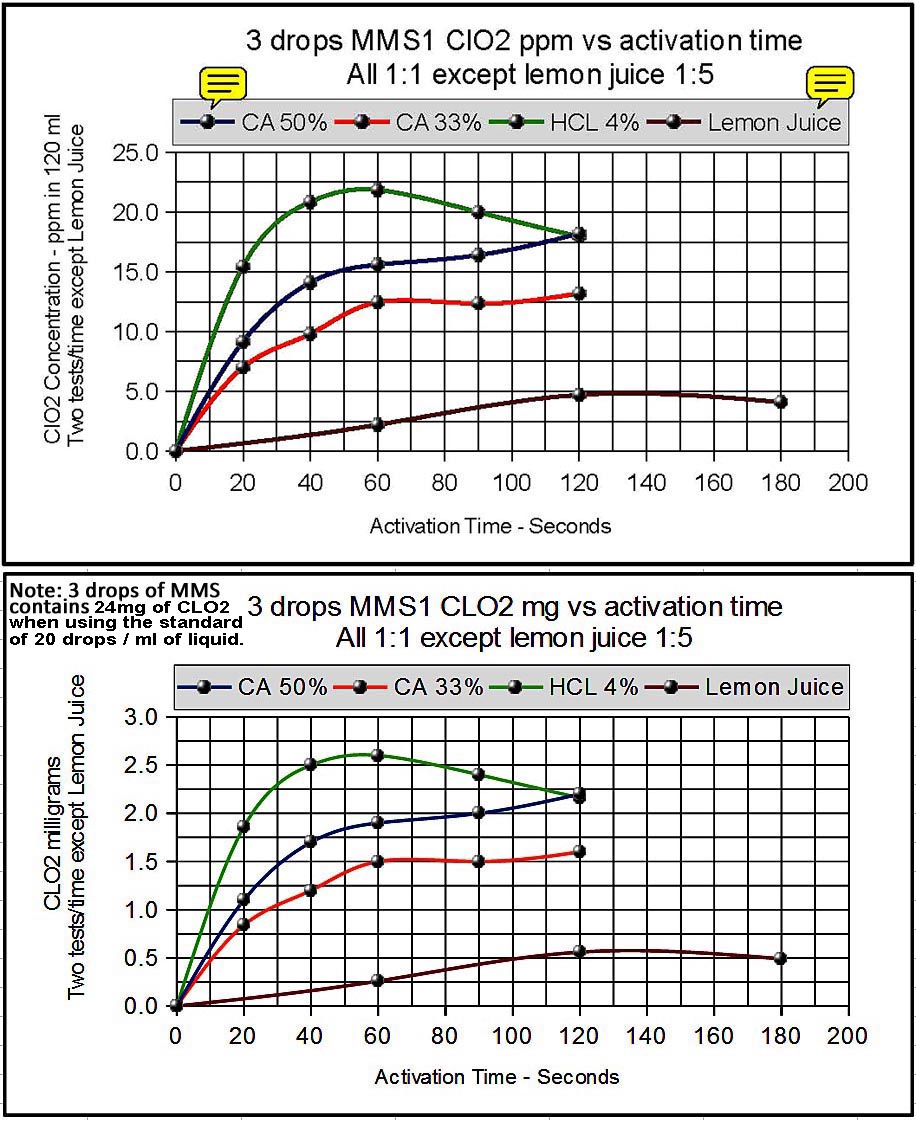
The residual SCS can be further activated in stomach acid and elsewhere in the body by other acidic substances.
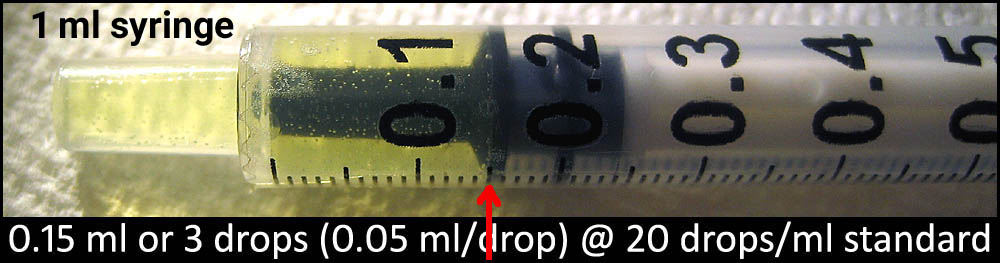
By the way, we use the international standard of 20 drops per ml of solution, so drop size is 0.05ml which can be measured with a 1ml syringe. Who knows the drop size dispensed by your droppers.
Now if one adds one ounce of water (600 drops) then the concentration would be 4 drops/604 drops or 0.0066 or 6,600 ppm. Is this correct? Adding water will dilute CLO2, yes.
The reason I ask is KV Labs offers NatriChlor, a Chlorine Dioxide Solution in 3,000 ppm concentration, That is CDS and not MMS1. and also a two part kit of Sodium Chlorite and Hydrochloric Acid. They state 3 drops of each added to 4 ounces of water will result in a 30 ppm solution. But according to my math, 6 drops/(4 x 600 + 6 drops) would result in a 0.0025 or 2,500 ppm concentration. Unless the concentration of Parts A & B are 0.01 (10,000 ppm) prior to adding water. What am I missing? My concern is what is a safe concentration level to use? If you follow MMS1 protocols, and heed the Three Golden Rules, your dosing should be fine. Jim Humble’s book specifies number of drops, and ounces of water, but I do not see any place where he mentions the actual concentration of the solution prior to consumption. Which of course would be determined by the concentration of both parts prior to mixing. Thank you in advance.
Last edit: 05 Nov 2025 22:20 by CLO2.
The following user(s) said Thank You: JimH1954
Please Log in or Create an account to join the conversation.
- Sir Ed
-
Topic Author
- Offline
- New Member
-
Less
More
- Posts: 2
- Thank you received: 1
06 Nov 2025 19:56 #87568
by Sir Ed
Replied by Sir Ed on topic Understanding drops of solution per ounce of water in terms of concentration
Thank you very much that was very helpful.
Please Log in or Create an account to join the conversation.
Time to create page: 0.282 seconds
The MMS HEALTH RECOVERY GUIDEBOOK is Jim’s latest book. It provides the latest information on how to safely use MMS. Click the book image to order your copy today.
Jim's Blog
-
Cravings/Weight Management/Blocked Veins
Published on: October 4, 2026
A conversation with Jim in 2010: D: Some doctors have told me that harmful pathogens have the ability to manipulate the brain chemistry to make you crave the things they want to eat. Since I have been on MMS/CD, I have lost all cravings. I have also lost 60 pounds (which I needed to lose), …
-
Flu Season
Published on: September 28, 2026
The flu is a lot more dangerous sometimes than people realize and flu can make you very, very sick. There are some flu’s today that are highly resistant to most everything. So with flu and colds that just won’t go away and with pneumonia, here is another suggested approach you can try if the standard …
-
Making Health Decisions
Published on: September 22, 2026
Following is Jim’s answer to someone who was struggling with trying to get a loved one to follow certain procedures regarding their health: Jim: It is important to understand, that what a person decides to do about their own health is a very personal matter. In addition, there are so many factors involved in making …
-
MMS/CD and Antioxidants
Published on: September 14, 2026
Some folks get confused and a bit hung up on the issue of MMS/CD and antioxidants. While it is true, we have said and many others emphasize, you cannot take MMS/CD with antioxidants. Fair enough, it stands to reason that taking antioxidants with an oxidizer is not the best thing to do. BUT, you have …
-
Why it’s Not Working
Published on: September 2, 2026
From a discussion with Jim on why MMS/CD doesn’t seem to be working: Jim: If it’s not working, do something different. But this can be tricky, you have to give each thing enough time to work, don’t be rash, but don’t stay stuck either, this is where listening to your body comes in and the …
-
Important Safety Tip on Mixing a Dose
Published on: August 17, 2026
Recently it has come to our attention that some people question if you need to take an MMS/CD dose in water. The answer is a big YES! All MMS (chlorine dioxide) doses, with whatever “variation” of MMS/CD one is taking, needs to be mixed in water. You NEVER take it straight. The standard is usually …